
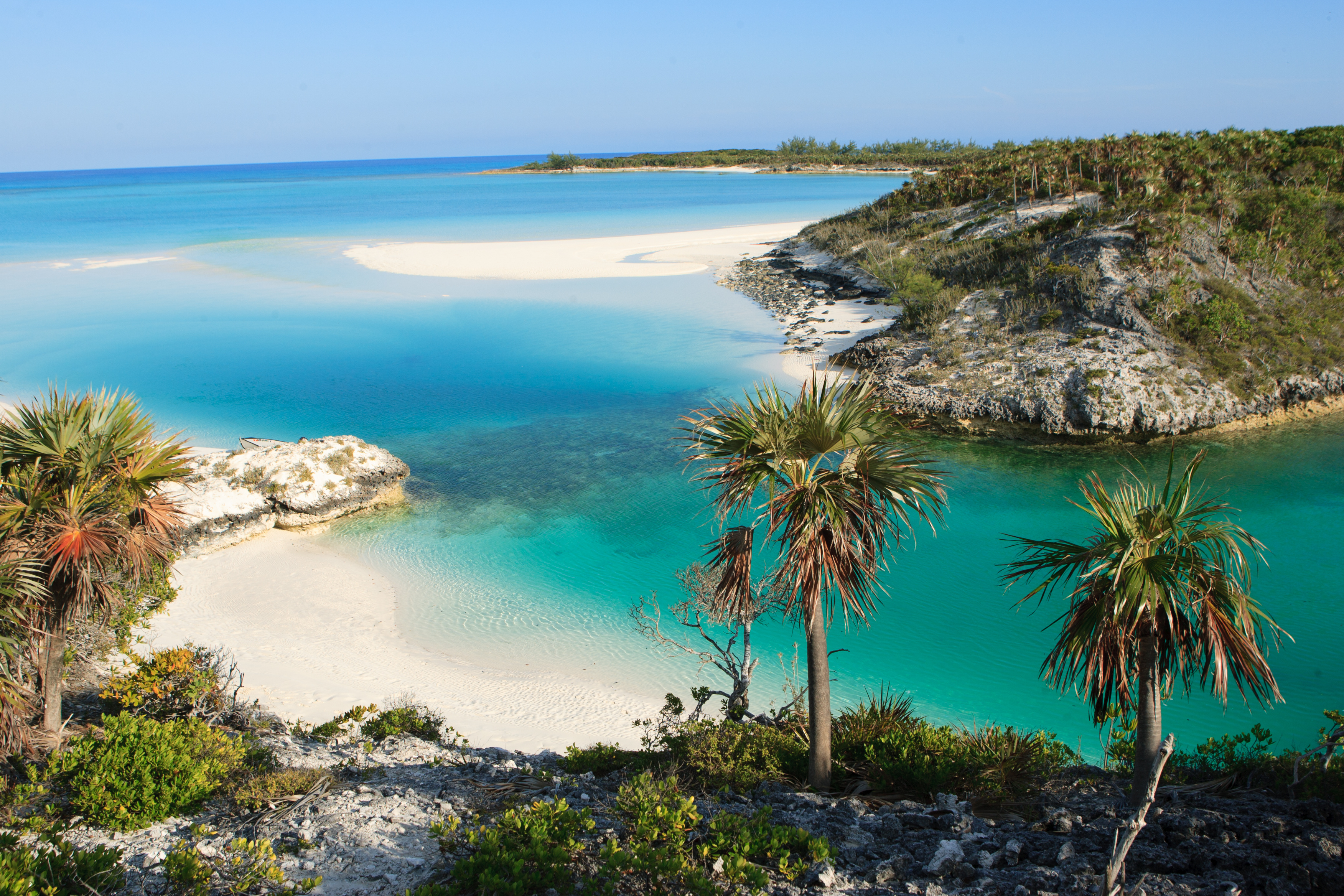
The Cays
The 365 cays of the Exumas — which ones to visit, how to reach them, and what to expect
Verified
Allen's Cay
The northernmost stop on most Exuma charter itineraries and the first significant cay south of Nassau for boats heading into the chain. Allen's Cay is the primary home of the Northern Bahamian Rock Iguana, a species endemic to the Bahamas and found nowhere else on earth.
The iguanas are habituated to visitors and will approach boats and people without hesitation. They grow to over four feet in length and can live up to 40 years. Grapes and lettuce are the commonly cited foods; many guides ask visitors not to feed them, though feeding appears routine in practice. They are harmless.
The beach itself is small but attractive. The cay is uninhabited. Most visitors spend 30–60 minutes here before continuing south.
Access: By boat only; roughly 40 miles north of Georgetown. First stop on most organized full-day excursions from the north end of Great Exuma, and a standard Day 1 stop on charter itineraries originating from Nassau.
Leaf Cay
A small cay adjacent to Allen's Cay, also home to a population of Northern Bahamian Rock Iguanas. Typically visited in the same stop as Allen's Cay rather than as a separate destination. Less visited and quieter than Allen's, with a correspondingly calmer wildlife encounter.
Access: Immediately adjacent to Allen's Cay; visited as part of the same excursion stop.
Norman's Cay
Norman's Cay carries more history than almost any other cay in the Exumas. In the late 1970s and early 1980s, Colombian drug trafficker Carlos Lehder, a member of the Medellín Cartel, took over the island, using it as a cocaine transshipment point between Colombia and the United States. Locals and other residents were forced out. The DEA eventually forced Lehder's departure in the mid-1980s.
What remains is the plane wreck: a Curtiss C-46 cargo aircraft that went down in the bay and now sits in the shallow water, partially visible at low tide, fully snorkelable. It is one of the more unusual dive and snorkel sites in the Bahamas, an intact (if weathered) aircraft in clear water, with good fish life around the fuselage. Visibility at low tide is best; currents at the site are manageable in calm conditions.
The island now has a small marina and a restaurant called MacDuff's, which draws sailing charter guests for dinner.
Access: By boat; a stop on northbound charter routes from Nassau. Approximately 55 miles north of Georgetown. Less commonly included in organized day excursions from Great Exuma.
Shroud Cay
Within the Exuma Cays Land and Sea Park, Shroud Cay is known for a single defining feature: a network of mangrove creek passages that run through the interior of the island, allowing visitors to dinghy or kayak from the protected leeward anchorage all the way through to an Atlantic-facing beach on the windward side. The passage is shallow and winding, with mangrove canopy overhead in sections.
The Atlantic beach at the end of the passage is consistently cited as one of the most remote and beautiful stretches of sand in the Exumas, no facilities, no crowd, completely undeveloped. The combination of the creek journey and the beach payoff makes Shroud Cay a highlight of the Land and Sea Park for sailors and charter guests.
No facilities exist on the island. All food and water must be brought aboard. This is a stop for self-sufficient boats.
Access: By boat only; within the Exuma Cays Land and Sea Park. Dinghy or kayak required to navigate the creek passages. Day 2 stop on charter itineraries heading south from Nassau, typically paired with Warderick Wells.
Warderick Wells Cay
The headquarters of the Exuma Cays Land and Sea Park and, by consensus among long-distance charter sailors, the most scenically distinctive anchorage in the Exumas. The cay features a well-organized mooring field, hiking trails, sand flats that expand dramatically at low tide, mangrove creeks with sea turtles and rays, and the famous Boo Boo Hill.
Boo Boo Hill is a short hike to a hilltop where generations of visiting boaters have left a painted driftwood plank or board bearing their boat or family name, a lighthearted tradition said to appease the weather gods. The accumulation of boards over decades makes it a genuinely evocative spot.
The mooring field is managed by the Park; reservations via VHF radio on the morning of arrival are the standard approach, though calling when within radio range has generally worked for experienced visitors. No anchoring within the Park boundaries. There are no restaurants and no provisions on the island. Arrive self-sufficient.
Wildlife around the cay includes sea turtles, spotted eagle rays, lemon and nurse sharks in the mangrove channels, and abundant bird life. The sandbars at low tide are extraordinary.
Access: By boat only; within the Exuma Cays Land and Sea Park. Moorings can be reserved by VHF radio. No facilities ashore.
Compass Cay
A small private marina where nurse sharks have congregated for so long that they are fully habituated to human contact, comfortable being touched, petted on the back and belly, and fed. They are uniformly gentle. The one consistent instruction communicated by the marina staff: do not put your hand in their mouths.
Beyond the sharks, Compass Cay has two additional features worth knowing:
- Cross-island trail: a roughly 30-minute walk through the cay's interior to an Atlantic-facing beach on the windward side. The contrast between the calm, turquoise leeward side and the open Atlantic surf is striking.
- Rachel's Bubble Bath: a natural formation on the Atlantic side where ocean swells crash over a rocky rim into a depression, creating a warm, foamy, naturally occurring jacuzzi effect.
A small grill on-site serves burgers and hot dogs at lunchtime (no dinner service). Marina slips can be reserved in advance.
Access: By boat; a standard stop on both organized full-day excursions from Great Exuma and charter itineraries. Approximately 65 miles north of Georgetown.
Staniel Cay
The most developed inhabited cay in the northern Exumas and the practical base for experiencing the cluster of headline attractions in this part of the chain. Staniel Cay has a small village, a functioning marina, a yacht club, and rental golf carts and bicycles, more infrastructure than any other cay in the area.
The Staniel Cay Yacht Club is the social center: dinner is served in two seatings (typically 6pm and 8pm). Lunch is also available, and nurse sharks are present at the dock steps.
The cay is the departure point for:
- Thunderball Grotto, a sea cave nearby (not on Staniel Cay itself) made famous by the James Bond film Thunderball and the film Splash. At low tide the entrance is exposed; at high tide entry requires an underwater swim. Visit at low tide. Strong currents exist, particularly further from the entrance, confident swimmers only. Sunlight through the ceiling openings illuminates the interior dramatically.
- Big Major Cay, the swimming pigs, a short boat ride away.
- Compass Cay, nurse shark swimming, accessible the same day.
A drug-running aircraft from the 1970s lies in the bay near Staniel Cay, partially visible at low tide and snorkelable.
Access: By boat; the terminus for most organized full-day excursions from Great Exuma and a central stop on charter itineraries. Ferry-style services to Staniel Cay exist but are limited.
Big Major Cay
Universally known as Pig Beach, Big Major Cay is home to the most famous attraction in the Exumas and arguably in the entire Bahamas: a colony of free-roaming pigs who swim out to meet arriving boats.
The pigs enter the water independently, they are not coaxed or pushed in. As a boat approaches, they swim out before it even lands. Visitors can bring carrots, fresh fruit, or vegetables to feed them. The pigs are large, food-motivated, and can bite, the consistent advice is to drop food rather than hold it out on a flat palm. Going ashore to walk the beach after feeding is possible.
The island is uninhabited by humans. The origin of the pigs is genuinely disputed; theories include sailors leaving them as a food supply and a deliberate tourism venture. The pigs' swimming behavior is considered natural by observers.
Big Major Cay is about a two-hour boat ride north of Georgetown. It is almost always visited as part of a full-day organized excursion or as a stop on a charter itinerary, there is nothing on the island itself except the pigs and the beach.
Note: A Nassau-adjacent pig beach experience has also been established near Athol Island (approximately 20 minutes from Nassau by boat). That is a separate operation from the original Exuma pigs. The Big Major Cay experience is the original and most established.
Access: By boat only; roughly 60 miles north of Georgetown. Included in virtually all organized full-day excursions from Great Exuma.
Private Islands
The Exumas chain includes privately held cays at the extreme end of the real estate market. At least one cay has been listed for sale at $125 million. The chain's combination of legal private ownership, protected anchorages nearby, and proximity to Nassau makes it the primary market in the Bahamas for ultra-high-end island acquisitions. For visitors, private cays are closed to access regardless of approach by boat; the distinction matters when planning anchorages along the chain.