
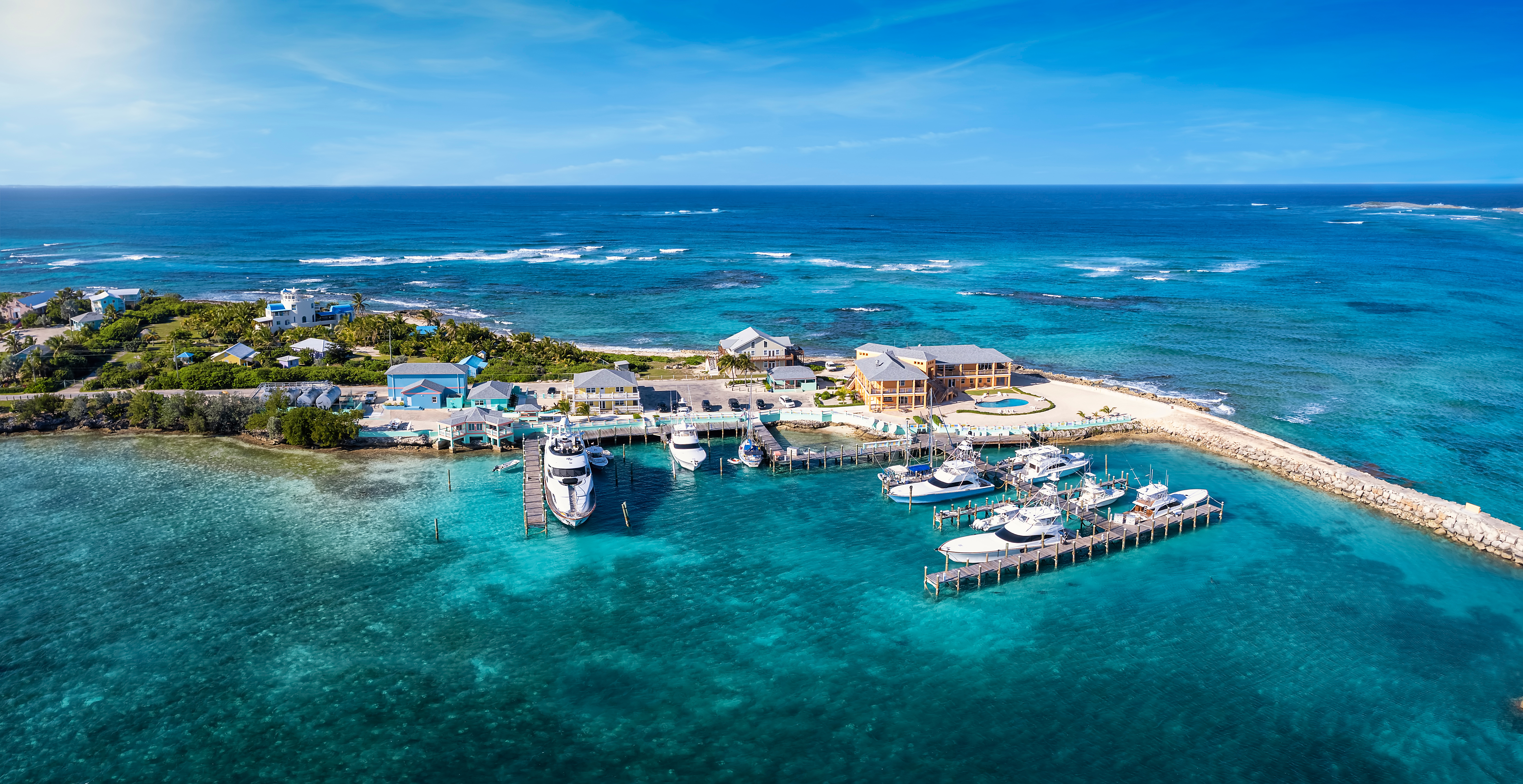
Long Island runs roughly 80 miles from northwest to southeast through the central Bahamas, rarely more than four miles wide. Two completely different coastlines define it: the western shore faces the calm, shallow Bahama Bank with white sand and clear turquoise water; the eastern shore faces the open Atlantic with steeper profiles, rougher conditions, and sand that runs distinctly pink near Stella Maris. The island straddles the Tropic of Cancer.
It draws divers, freediving enthusiasts, and travelers who want world-class beaches without crowds. Cape Santa Maria Beach ranks consistently among the best beaches in the Bahamas. Dean's Blue Hole is among the most significant dive and freediving sites on the planet. The island receives far fewer visitors than Nassau, Harbour Island, or the Exumas. Solitude here is not a selling point manufactured by resort marketing; it is simply the condition of the place.
Dean's Blue Hole
Located in a calm bay near Clarence Town on the southeastern end of the island, Dean's Blue Hole is the third-deepest blue hole in the world, measuring 663 feet from the surface to the bottom. From the water it appears as a circular, dark indigo opening set within a sandy bay; the seafloor drops from shallow edges to significant depth almost immediately.
It is free to visit and open to the public. For casual snorkelers and swimmers the sandy surround and extreme clarity of the water make it a striking experience without requiring any depth. Freediving is where Dean's Blue Hole has its international reputation. Vertical Blue, often called the Wimbledon of freediving, has been held here, drawing elite competitors who use the hole's depth column for world-record attempts. The competition schedule varies; verify before planning a trip around it.
The blue hole is about 15 minutes by car from Clarence Town. No facilities on site; bring water.
Cape Santa Maria Beach
On the northern tip of the island, Cape Santa Maria Beach is a four-mile arc of white sand on the protected western shore, sheltered from Atlantic swell and typically calm. The water is shallow, clear, and consistently turquoise. It is one of the most photographed beaches in the Bahamas and frequently listed alongside Harbour Island's Pink Sands Beach in regional beach rankings.
Cape Santa Maria Resort sits at the beach's northern end and is the main accommodation option for this part of the island. The beach itself is wide and largely uncrowded. Non-guests use it freely. The northern tip of Long Island is also one of the best spots on the island to watch the sun set over the Bahama Bank.
Clarence Town
The island's administrative capital sits on the southeastern shore, roughly 55 miles south of the northern tip. Its most distinctive feature is a pair of churches built by the same man: John Hawes, a trained architect known as Father Jerome, who first served as an Anglican priest and then converted to Catholicism. He built St. Peter's Anglican Church first, then crossed the road and built St. Paul's Catholic Church after his conversion. Both are built in a similar Gothic Revival style with twin spires visible from the sea. Father Jerome later built the Hermitage on Cat Island, his best-known work.
Clarence Town is a quiet settlement with a few restaurants and local shops. It is the closest town to Dean's Blue Hole and the practical base for exploring the southeastern end of the island.
Stella Maris
About halfway up the island on the Atlantic-facing eastern shore, Stella Maris has one of the oldest dive operations in the Bahamas. The Stella Maris Resort Club runs dive programs including wall dives along the Bahama Bank edge, the Comberbach wreck (a 103-foot freighter sunk as a dedicated dive site), and shark dives at Shark Reef. The eastern shore here has the pink-tinted sand that comes from foraminifera shells, similar to Harbour Island's famous beach, set against a more dramatic Atlantic coastline than the western side.
Stella Maris Airport (SML) serves this part of the island. It functions as the dive hub of Long Island; Cape Santa Maria is the beach hub.
Practical Notes
Getting there: Fly into Stella Maris Airport (SML) in the north or Deadman's Cay Airport (LGI) in the south, both via Nassau. Flight time is roughly 45-55 minutes. Makers Air runs limited scheduled service from Fort Lauderdale Executive (FXE) to Stella Maris during peak season. A seasonal ferry connects Long Island to Exuma. Allow extra connection time when transiting through Nassau from an international flight.
Getting around: A rental car is essential. The island is 80 miles long and the main areas, Cape Santa Maria and Stella Maris in the north and Clarence Town in the south, are roughly an hour's drive apart. The Queen's Highway runs the full length. Road conditions vary; potholes are common in sections.
Budget: Long Island is noticeably more affordable than Harbour Island and the upper Exumas. The two main resorts are mid-range to upscale but not at the Harbour Island price level. Vacation rentals scattered across the island offer the most affordable entry point.
Season: November through April is peak season. Hurricane season (June-November) carries real risk; travel insurance with cancellation provisions is strongly recommended for trips in that window.
Prices, operating hours, and business details change; verify before travel.